Topics of Interest
Welcome to my blog site. Here I share various topics about me and my interests. Also, the links above will bring you to a separate page for my blog topics.
10/4/2026 – Fake News Around Elections: An analysis about fake news around the time of elections. How to identify fake news, what tools/methods to use, and what should you do about it.
Target Audience
This blog post is intended for the baby boomers and younger generations. This blog post assumes its readers are at least slightly knowledgeable in working with computer technology as there is reference to lateral reading, browser tabs, and browser extensions. People who have no higher education and performed poorly in academia may find this blog post more insightful as these readers are less likely to have community support, like a college, to help illustrate to them what fake news looks like particularly around elections.
Medium/Approach
This content is being relayed as a textual blog post with some images, so it assumes its readers know how to access a website at least. A textual blog post regarding fake news and elections content is the most effective approach as it can always be revisited and searched for key words. There are specific references provided that aim to help identify fake news and what tools and methods you can use to approach it when you’re unsure.
What is fake news?
Today we are going to be taking a deep-dive and explaining a concept of misinformation called fake news particularly around elections. According to the Cambridge dictionary the definition of Fake News is false stories that appear to be news, spread on the internet or using other media, usually created to influence political views. In today’s blog we are going to go through a real-life example of fake news content based around elections. By the end of this blog post my goal is for you to be able to identify more clearly if news is fake or not, what tools or methods you can utilize to verify news credibility, and what you should do with fake news when you encounter it.
Real-Life Fake News Scenario
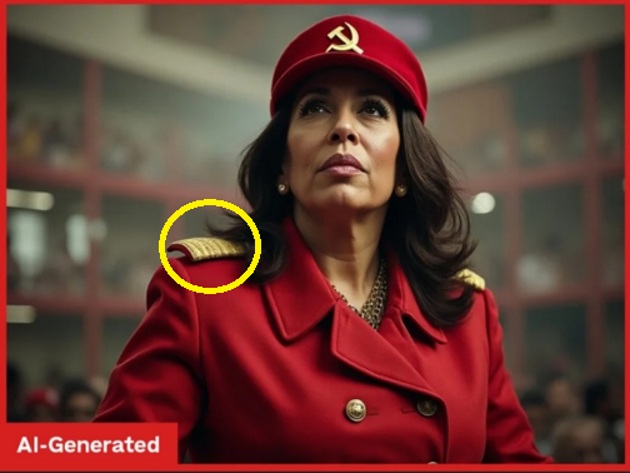
In September of 2024 Elon Musk re-posted on X an AI-generated image of Kamala Harris wearing a Communist Garb.

Source: AI-generated images have become a new form of propaganda this election season
In the Fall of 2024, Kamala Harris was running to be the next President. When Elon posted this AI-Generated image of Kamala wearing a Communist garb, it made her seem un-American. Rest assured, Kamala Harris is proud to be an American and never wore a Communist garb.
How to identify what’s fake?
The image of Kamala wearing a Russian garb looks real. To an untrained eye, someone might believe that Kamala wore this. If news like this sounds shocking to you, causing you to wonder if it’s true or not, there are ways to identify if an image is real just by looking at it. According to Kellogg’s School of Management 5 Telltale Signs That a Photo Is AI-generated one way to see if an image is AI-generated is if the person’s skin is waxy or shiny. The fictional Kamala in the AI-Generated image having waxy, shiny cheeks is a clear sign that the image is fake. Kellogg’s School of Management also says to look for violations of physics such as gravity. In the AI-Generated image please note the patch on Kamala’s right shoulder. The patch looks like it’s floating mid-air as circled here.
What tools/methods to use?
John Green, an author of the CrashCourse video series, offers a new way to research if news content is fake or not inside the digital space. John in the video Check Yourself with Lateral Reading: Crash Course Navigating Digital Information #3 explains a new concept called lateral reading. Instead of traditionally reading up and down through a source to determine its validity he explains the more effective way is to read laterally in a browser, essentially opening new tabs and looking for additional sources of information that would determine if the first source of content you are looking at is fake or not. You’re essentially laterally reading across different browser tabs to see if there is consistency in what your content is claiming. If there is consistency, then likely the content is real, if no consistency, then likely it’s not.
Circling back to the realm of fake news with elections, you may be asking how do I know the sources I’m laterally reading with are valid sources to begin with? Good news! There are dedicated news services out there to combat fake news. Newsguard for example has News Reliability Ratings with a list of over 35,000 news sources. One service they offer is to give news sites ratings basied on their credibility. So, if you’re on a site that is spreading statements about elections, yet it has a low rating on Newsguard likely those statements from that news source is false and can be considered fake news. (If you’re like me and like to save money yet still have access to an awesome tool that Newsguard offers, they have a free browser extension that works with Microsoft Edge. Please note, their extension is free only with the Microsoft Edge browser and nothing else. Their extension with Chrome is $8 a month.)
Particularly with elections, there are many top news sites that favor a political party. For example, CNN favors the Democratic party, Fox News favors the Republican party. So, when you visit their websites you will see drastically different election stories being reported, and the stories they do both report on are highly different in their point of views. Reporting content that is favorable to one side of a political party is almost like fake news as it leaves out the perspective of the other political parties. People tend to believe what they last read most favorably. Thankfully, there is a tool at your disposal that strives to not favor any political party. Allsides does this by presenting articles that favor the Democratic and Republican party. That way, you the reader can be confronted with the left (Democratic) and right (Republican) news.
What should you do?
Shortly before elections, fake news becomes increasingly rampant. AI is also seeing a technological boom so you will increasingly see photos and videos generated by AI. Understanding the definition of fake news and looking for the tell-tale signs of AI content published by Kellogg’s School of Management (see above) you can better protect yourself from mistakenly believing news that is fake. Furthermore, when confronted with news content that you suspect may be fake, perform lateral reading by checking a few other sources with browser tabs. Another tool at your disposal is the Newsguard service that gives news services based on their overall credibility. Lastly, when you find fake news do your part. Do not share it with others.
References
https://dictionary.cambridge.org/us/dictionary/english/fake-news
https://www.npr.org/2024/10/18/nx-s1-5153741/ai-images-hurricanes-disasters-propaganda
https://insight.kellogg.northwestern.edu/article/ai-photos-identification
https://www.youtube.com/watch?v=GoQG6Tin-1E
https://microsoftedge.microsoft.com/addons/detail/newsguard/cgooaaonimepbcidkhgmanahfbinpjdm
https://www.newsguardtech.com/solutions/news-reliability-ratings/
9/20/2026 – Curbing Misinformation Assessment: A closer look at Facebook and Instagram’s practices and procedures to curb misinformation.
Overview
In today’s world, many social media sites struggle with handling misinformation on their platforms. Today, we are going to get a closer look at how Facebook and Instagram have tried to curb misinformation around social issues. Recently, Meta, parent company of Facebook and Instagram announced they now require advertisers who use their platform to disclose when AI was used when posting ads about social issues, elections, or politics. Reference: Helping People Understand When AI Or Digital Methods Are Used In Political or Social Issue Ads.
How Policies/Procedures are used
To make their origin of content more transparent, Meta says content that was disclosed to be generated from AI, will now have a label that says AI Info. If an advertiser posts content that is AI generated but did not disclose this to Meta, their ad will be rejected. Repeated failures to disclose may result in penalties against the advertiser.
Merits of policy/personal experience
While Meta’s blog post referenced above signifies the platforms of Facebook and Instagram have a problem with misinformation (or the blog post wouldn’t exist if it didn’t) these new policies do very little to retreat misinformation. Misinformation instead is on the rise. WLRN, a PBS and NPR member station quotes Daniel Trielli, an assistant professor of media and democracy at the University of Maryland. “We have had much more volume of misinformation, disinformation grabbing the attention of the electorate”. Reference: Midterm elections likely to see increased effects of misinformation, reduced security, experts say.
Through my personal experience I have seen a ton of AI content about politics on social media yet I have never seen it with an AI Info label despite Meta saying the label is required. Meta put forth they were going to enforce this but it was never done. For example, here is a link of Donald Trump pushing a John Deere Donald Trump model lawn mower. What A Fukn Moron. Clearly, there is no such thing as a Donald Trump lawn mower from John Deere, but the fake video seeks to portray Donald Trump as having similar IQ of a child who plays with kids toys. AI content such as this is rampant on Facebook and Instagram. In the example I gave above, I visited Tracy Jewell’s Facebook page, the host of this fake video, and there are a ton of other fake videos published by this person. This is an example of a failure on Meta’s part to remove fake content.
Plus, the punishment for those who violate Meta’s policy is comical. The worse an advertiser could face if they don’t disclose their content is AI generated the first time is a rejection of their ad being posted. With repeated offenders, Meta offers vague terminology that they may face penalties. What kind of penalties are not specified. Unspecified penalties is not going to deter anyone away from posting AI content with misinformation which explains why I have never seen AI content with the label AI Info on it.
Suggestions for improvement
Punishments published from Meta for offenders not disclosing their content that is AI generated needs to be more severe and specific. If it were up to me, the first time, a rejection of the ad is ok. Repeated failures though, I would be more specific and say that repeated offenders can face up to $10,000 in fines and possible jail time. There needs to be a sense of fear instilled into people who do actions like this otherwise, misinformation will continue to spread. Having a monetary punishment for violators would lower the spread of misinformation as no one I know of would want to lose $10,000 for spreading lies. The potential jail time too would further instill fear into spreading fake news. While spreading misinformation may be unintentional, unlike disinformation, having punishment safeguards in place such as fines and jail time would make advertisers be more thoughtful before posting content.
A problem I think Facebook and Instagram has is the sheer volume of AI content to monitor. The volume is too large to keep up with. In speaking from my own work experience in IT support, an idea I have to reduce misinformation is to have AI content have its own file type. For example, most videos generated from AI use an MP4 file format which is the same as many other non-related AI videos. If all videos generated by AI also used their own file type, that would make the flagging of this content much easier to find for Facebook and Instagram. The RTG file name extension is not used yet. RTG letters are used in the words artificial intelligence. If all AI videos used this specific file type, it could effectively signify to social media platforms that this type of content is AI generated.
9/12/2026 – Claim Analysis: There is an abundant amount of online information out there. Unfortunately, the amount of claims that are not true have spread online vast and far. Today, we are analyzing one claim and dissect it to understand how truthful it is.
Overview
Someone I know close to me shared a video reel with me on Facebook messenger. The video reel is from someone named Michael Knowles Sh. Here is the video preview:
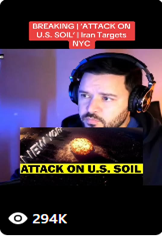
Here is the link to the video reel: BREAKING | ATTACK ON U.S SOIL | Iran Targets NYC
The words “BREAKING | ATTACK ON SOIL | Iran Targets NYC” highlighted in red sounds startling plus the number listed on the bottom left indicates how many views this video reel has received. 294,000 views makes me think there must be some truth to this right? I played the video reel. Michael is claiming that Iran is going to be targeting Manhattan and Wall Street with asymmetric warfare. Per Michael they want to take out America’s telecommunications and water systems, and power grids. Then this person says this is all coming from a warning from an IRGC advisor and that there will be multiple attacks.
Initial reaction
The source of this information is not credible, so I was skeptical even before playing the video. If I saw this posted on a national news station like CBS, ABC, or NBC I would likely believe it but seeing this on a video reel on Facebook immediately had me thinking this is hyped up hysteria. The extremity of the video preview is a red flag for me as well. It’s not subtle at all, meant to entice you to play it, essentially clickbait.
Analyzing the Claim
My goal after watching the video reel is to determine how truthful is the content. Before determining that though, I had the following questions:
- What does asymmetric warfare mean?
- What’s the IRGC?
I started to do some lateral reading by opening a new tab and going to google.com. I asked Google what does asymmetric warfare mean? Definition: A military conflict between opposing forces with a significant imbalance in power, resources, or technology, where the weaker side uses unconventional tactics to exploit the stronger side’s weaknesses. (Wikipedia). Next, I asked Google what’s the IRGC? IRGC is the Islamic Revolutionary Guard Corps. Now knowing this I rewatched the video.
Claim Validity
This is where it got interesting. I continued my lateral reading by opening another new tab and asked Google did IRGC say they will attack Manhattan? One credible top source appeared, Iran International that verified the IRGC did say it would attack Manhattan if they ran out of missiles. Here is where things got even more interesting. I went to Bing.com and asked the same question. Many more sources related to this appeared on Bing than they did on Google. The sources that appeared on Bing reiterated what Iran International said on Google. Here is a screenshot comparing my Google results and Bing results:
| Google results | Bing results |
The top searches in Google yielded to only one news site related to my question. The top searches in Bing all resulted in news sources related to my topic. This is important because if someone went to only Google to research something they could find only a fraction of meaningful resources that are out there.
Verdict
While the video reel consists of notes of truth, the way it is presented exaggerates the severity of the story. Yes, the IRGC stated it would consider attacking Manhattan if it ran out of missiles, but Michael creates hysteria in this video reel by saying they want to attack America’s power grids, water supply, and telecommunications grid. Per Michael it would be multiple attacks as well. No specificity like this was given from the IRGC. So, what Michael does here is create hysteria by literally making false statements about how they want to attack America’s infrastructure without providing specifics. Tagging that along with the headline of this video reel “BREAKING | ATTACK ON SOIL | Iran Targets NYC” makes it seem that Iran already attacked NYC. The news is breaking and the words read attack on soil, Iran targets NYC.
Conclusion
I’m confronted with content like this almost daily. I rarely go into a deeper dive into a claim like this using lateral reading and the SIFT (Stop, Investigate the source, Find Better Coverage, and Trace claims) method. After I used these tools on this claim, I feel more knowledgeable now knowing what the truth is, yet at the same time my instinct was right before watching the video. This is someone on Facebook who takes a statement and makes it sound way more apocalyptic than it actually is and adds on his/her own fake content. I have a genuine dislike for people who post content like this, ultimately deceiving the world around them for their own personal gain, clickbait, which in this case generated 294,000 views.
9/5/2026 – Evaluating Misinformation: Today we analyzed and evaluated a couple of misinformation education tools. We are taking a deeper dive into the tools RumorGuard and Fake It To Make It.
Rumor Guard
Explanation
Rumor Guard seems to be a fact-checking site to guard against fake news. When you first visit the site you are brought to various tiles each with flagged fake news stories. These are recent stories which the site refers to as recent checks. The site illustrates if a story is fake or not by 5 factors. Authenticity, source, evidence, context, reasoning. If I go to the site’s Recent Checks page, it shows news stories that lack at least 3 out of the 5 factors. If a story lacks at least 3 factors, that seems to be the benchmark that determines the news story is fake. It teaches people the common trends (the 5 factors) that fake news lacks. Rumor Guard seeks to protect people from believing fake news by taking content and showing what factors they are flagged for.
Effectiveness
Rumor Guard has the potential to be effective. Before taking this class I’ve never heard of it. I think it will grow in popularity over the next few years now as fake news and AI becomes more rampant. I think fake news will increase because of AI which is easier to generate now than in the past. Rumor Guard is easy to comprehend making misinformation simple to read for its participants.
Commentary
I think Rumor Guard is a great tool for anyone to learn how to decipher whether or not certain content is fake. The enticing tiles on their website that showcase trendy news stories easily invite their audience. Rumor Guard does a nice job of keeping their audience engaged by inviting them in to read more and along the way, learn how to spot misinformation by using their 5 factors. According to Pew Research’s article How Much of the Internet Is Written With AI? currently ‘9.6% of all websites show significant AI editing or authorship.’
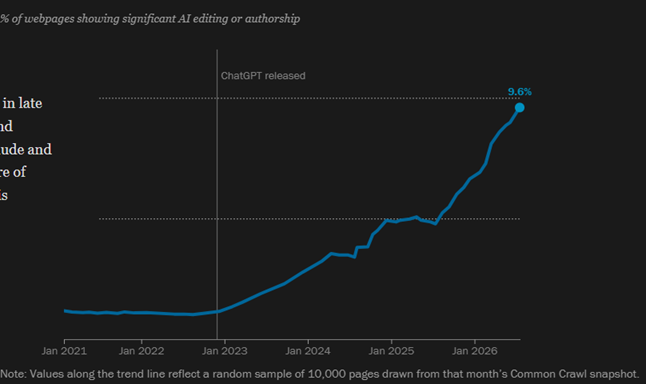
This line graph from the Pew Research article shows the number of AI edited or authorship websites have increased seemingly exponentially over the past 4 years. This boom in AI content should also popularize data tool sites like Rumor Guard to decipher fake content accurately.
Fake It To Make It
Explanation
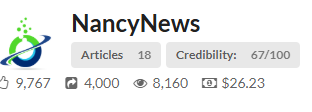
Fake It To Make It is an online game where you gain more money the more you spread fake news. How it works is you select fake news stories, select who to distribute the stories to, and select which groups to distribute the stories to. The member you select defines what groups to select as the groups shown are what the member is a part of. I found the most success in playing the game by aligning what subject tags the news stories are to the subject tags of the member and group distribute to. What Fake It To Make It does is provide a simulation on how ads gets generated behind the scenes onto your social media sites. I took it the result of the game is to make as much money as you can distributing fake content. Go NancyNews!
Effectiveness
The game is kind of comical how it all works but there is some validity in how it works in the real world. Fake It To Make It is a very effective tool in mitigating misinformation as it points out to its users what the end goal is. To make money. As I was distributing these fake stories, I also realized how much the end users are victimized. I always hear the phrase data sells and this game made me realize more how its users are really just products to sell to from content creators. I played Fake It To Make It for a while genuinely curious what happens if I keep playing. Here is how NancyNews fared:
Commentary
I think if more people used Fake It To Make It less people would use social media. The other day when I was on Facebook it seemed about 80% of my news feed was filled with ads and fake videos. People don’t often enough take a step back and ask why are they receiving all of this fake content. For what purpose. What Fake It To Make It sends home is that the ultimate goal of spreading information, no matter true or not true is just to receive your engagement to receive profit. This makes me want to get away from social media even more. Besides that though, I found this online game about misinformation amusing yet educational as well. Here is an interesting article from the BBC network, How X users can earn thousands from US election misinformation and AI images that discusses how people monetize spreading misinformation. One particular person the article mentions goes by Freedom Uncut who literally made thousands of dollars every month by posting AI and satirical content on X.
8/30/2026 – 24-Hour Media Diet: Over the past 24 hours I documented all of the types of media I consumed. They are documented with time stamps. What a realization! Documenting it really made me see how much time I was using on media even only in 24 hours. Let’s begin!
>>> 11:15 AM – Having breakfast and checking out my text messages. My younger sister sent me a couple Tiktok videos. One of the videos says ‘I asked my siblings to send a photo every hour to see how different our lives are.

>>> 11:45 AM – I am intrigued what my sister sent me so I reply back to her with a picture of me and my son.

>>> 12:15 PM – I login to Facebook and see a post from the Tesla Model 3 Club group about Full Self Driving. I try to comment but for some unknown reason I’m blocked from posting to the group. I attempt to contact the admin of the group to fix this but have no success.
>>> 1:52 PM – I’m checking my Facebook Messenger for video reels sent to me from a couple of my connections. There are 4 to check. One is how to make atomic nuka cherry ice cube pops from an ice tray, one is some broken link about Instacart, one is about Bruce Blakeman criticizing Kathy Hochul’s policies, and last one shows 4 different kind of antique can openers. For anyone unaware, Bruce Blakeman is running against Kathy Hochul for the governor position in New York State.
>>>1:59 PM – I’m checking my phone for old e-mails I can delete. I have a Yahoo, two gmail, and AOL e-mail addresses. I delete 5 e-mails. Some of them are college advertisements to enroll my daughter who is going to college next year.
>>> 7:00 PM – I go to a fair with the family and see a demolition derby. I take pictures and videos of it on my phone.
>>> 9:38 PM – I upload the pictures I took at the demolition derby onto Facebook.
>>> 11:15 PM – I login to Facebook to see if anyone reacted to my post. I have one like and one comment from my cousin saying he’s participating in the derby finals tomorrow.
Reflection: The last 24 hours was a real eye opener. I spend more time on Facebook than I realized. Throughout the day I spend very little time away from media. It almost is like a 2nd job I do throughout the day. Not only am I taking in what content I’m seeing, I’m taking time to post back with my own digital content. I saw less questionable content than I expected. I think I am already skilled at recognizing fake or questionable content yet see a vast multitude of it every day. When I login to Facebook I definitely see a trend of posts from Tesla related Facebook groups. Some bogus ones, some not. Because Facebook knows I am in the Tesla Model 3 Club group, they are inclined to see me updates from them and other similar groups. I’m inclined to fact-check stories I hear about Tesla full self driving. It seems whenever there is a news story about a Tesla accident, mainstream media is quick to point out it was a Tesla and state full self driving may have been the cause even they though have no proof. I find myself getting sucked in and fact-checking stories like these. I am interested in fact-checking full self driving news stories because it interests me compared to other news stories.
| SeanVesley.net | Designed with WordPress |